
Mutual Funds Guide: How to Choose the Correct Mutual Fund (Without Losing Your Mind)
If you’re building a mutual funds guide for yourself for the first time, here’s the good news: you don’t need to be brilliant at this. You just need to avoid being stupid. That’s not me being cute — it’s borrowed straight from Charlie Munger, who built a fortune on the idea that avoiding dumb mistakes beats chasing genius moves. This guide is your “avoid stupidity” checklist for mutual funds.
Before we get to how to choose the correct mutual fund, let’s look at the categories you’re actually choosing from.
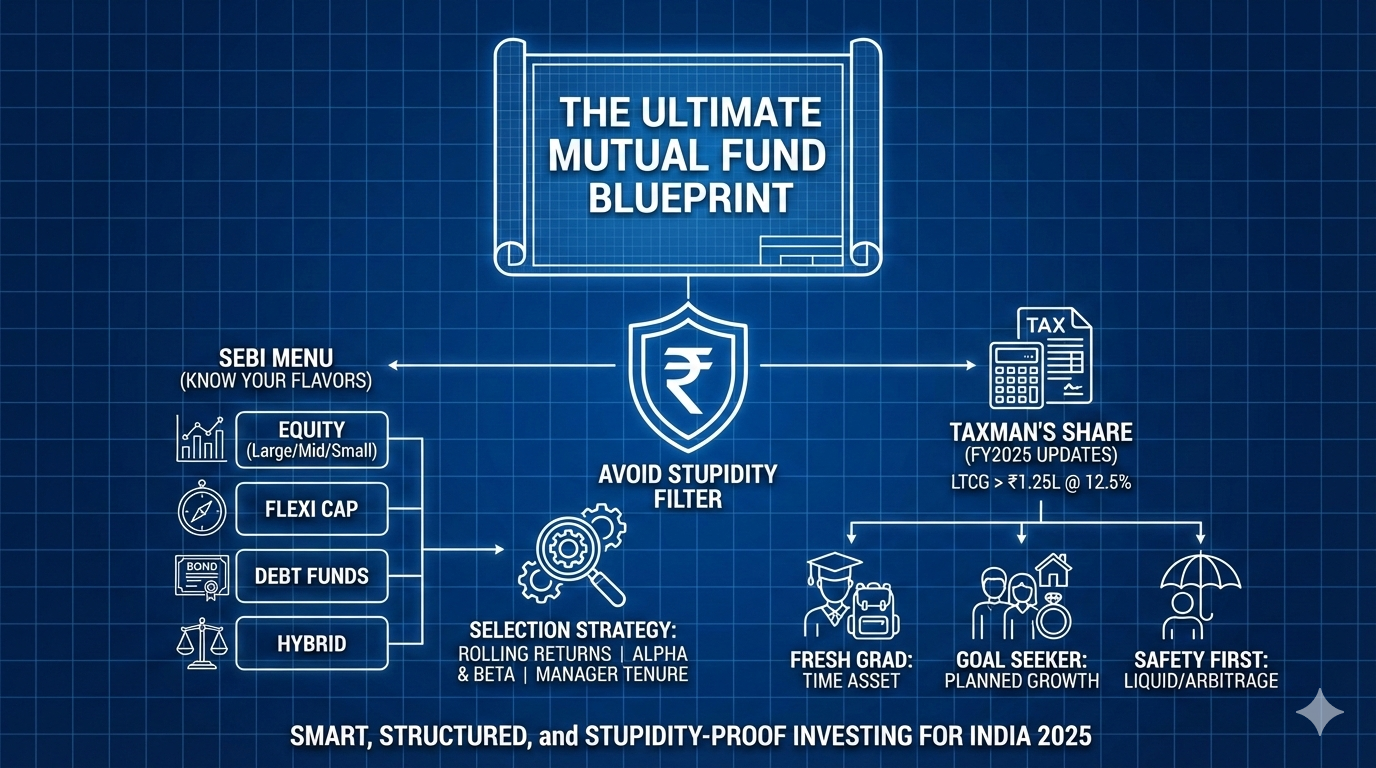
Mutual Funds Simplified: Know Your Fund Categories
SEBI (the market’s referee) has strictly categorized funds so AMCs can’t trick you with fancy names. Here’s the honest cheat sheet:
Equity: Large Cap — Top 100 giant companies. Don’t pay high fees here; consider an Index Fund instead.
Equity: Mid/Small Cap — Mid-sized to tiny companies. High octane. Only for money you don’t need for 7+ years.
Flexi Cap — The fund manager goes wherever the profit is. The “one fund” solution for most young investors.
Debt Funds — Loans to Govt/Corporates. Use this for goals under 3 years. It’s for safety, not wealth.
Hybrid/Multi-Asset — A mix of Gold, Equity, and Debt. Great for “calm” investors who don’t like too much volatility.
The Cost of Doing Business (Updated 2025)
In December 2025, SEBI overhauled the fee structure. If you aren’t tracking this, you’re quietly leaking wealth.
Base Expense Ratio (BER): The new “annual fee,” now capped lower — around 0.90% max for Index funds. Always check the Direct Plan; it’s cheaper than “Regular” because you aren’t paying a middleman.
Exit Loads: The “breakup fee.” Most equity funds charge 1% if you leave within 12 months. Avoid stupidity: don’t park emergency cash in a fund with a 1-year exit load.
Tracking Error: For Index funds, this is the only metric that matters. It shows how much the fund “missed” the actual market return. Lower is better.
The Taxman’s Share: The New Rules
As of July 2024/2025, the tax rules changed. If you don’t plan for tax, your “15% return” is actually much lower than it looks.
Equity Funds (>65% Equity):
- Short Term (under 1 year): 20% flat tax. Ouch.
- Long Term (over 1 year): 12.5% tax on gains above ₹1.25 Lakhs.
Debt Funds: No more indexation benefit. Gains are simply added to your income and taxed at your slab rate (10%, 20%, or 30%).
How to Choose the Correct Mutual Fund: The 3-Step Filter
Stop looking at “1-Year Returns.” That’s like judging a marathon runner by their first 100 meters. Use these Munger-approved metrics instead.
Rolling Returns (3yr/5yr): Instead of one fixed date, this looks at returns across every possible 3-year window. It tells you if the fund is a consistent performer or just a one-hit wonder.
Alpha vs. Beta:
- Alpha is the “magic sauce” — did the manager actually beat the market?
- Beta is the “vomit index.” If the market falls 10% and this fund falls 15%, it has high Beta.
Fund Manager Tenure: If the manager who made the fund famous just left, the past performance belongs to him, not the fund.
Mutual Funds Guide by Life Stage: Where Do You Fit?
The Fresh Grad (Early 20s): Focus on Small/Mid Caps and Flexi Caps. You have the “time asset” — you can afford to wait out a market crash.
The Goal Seeker (Late 20s–30s): Planning a wedding or house? Use Aggressive Hybrid or Large & Mid Cap funds. You need growth, but you can’t risk a 40% drawdown right before you need the cash.
Safety First (Emergency Fund): Use Liquid Funds or Arbitrage Funds — taxed like equity, but behave like debt. A genuinely useful tax hack.
The “Avoid Stupidity” Checklist
Before you hit invest, run through this:
- Is it a Direct Plan? Don’t pay commissions if you’re a DIY investor.
- Do I have an emergency fund? Don’t sell your mutual funds in a panic to pay a hospital bill.
- Is my goal at least 5 years away — like retirement or a child’s education? If not, stay away from Small Caps.
- Am I overlap investing? Owning 5 different Flexi-cap funds is just owning the same 50 stocks five times. That’s not diversification — it’s clutter. Real diversification comes from different fund houses, different investing styles, and different categories.
Not sure where to start? Try our free SIP Calculator to see how a monthly investment could grow based on your goals, or read SEBI’s own mutual fund category guidelines for the official word on how funds are classified.